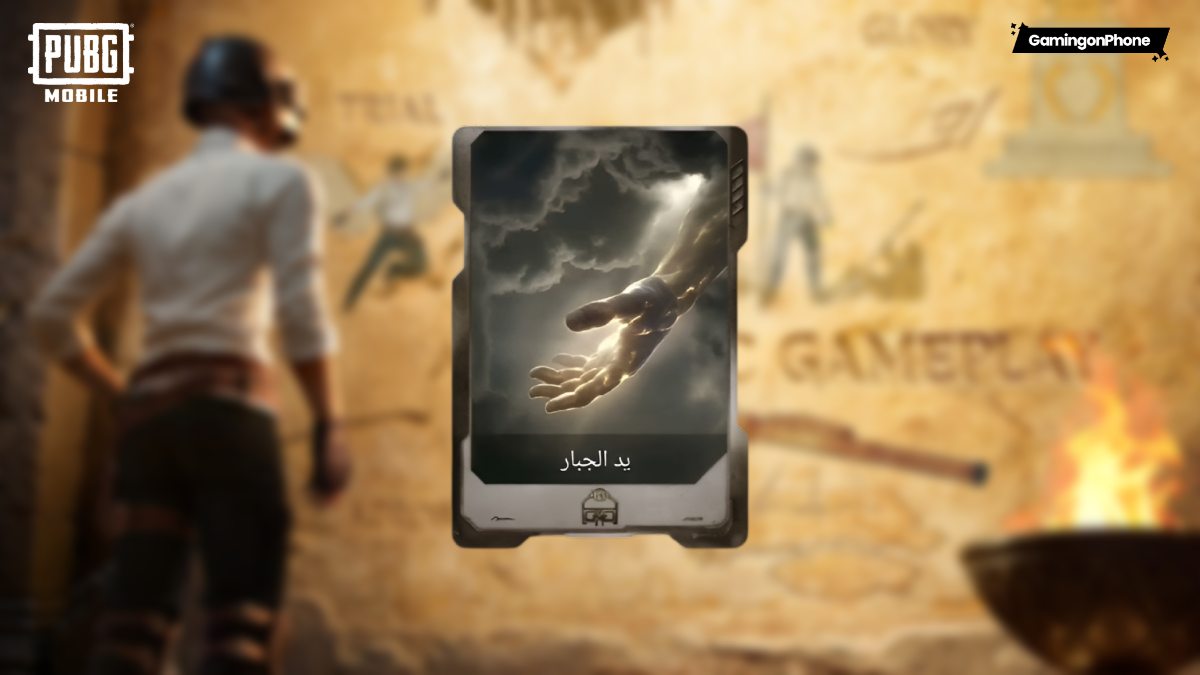
PUBG Mobile removed the “Hand of the Almighty” item and issued a public apology when Muslim players voiced dissatisfaction
- PUBG Mobile removes “Almighty Hand” card item after backlash.
- Muslim players said the name of the item did not respect Islamic beliefs.
- A similar religious controversy also occurred during PUBG’s Jungle mode several years ago.
PUBG Mobile has officially apologized and removed newly added in-game items following backlash from parts of the Muslim player community. The controversy was related to the card item called “Hand of the Almighty,” who arrived with the game v4.4 update.
After criticism spread online, PUBG Mobile released an official statement saying sorry and “deeply regret the hurt and suffering” caused by the item and confirmed that the item has been immediately removed from the game.
PUBG Mobile apologized and promised a stricter content review process
The discussion came mainly from Muslim players who felt the words crossed sensitive religious lines. Many argue that the use of terms related to divine qualities in an entertainment product does not respect Islamic beliefs and the holy qualities of Allah.
One player commented that the concerns were not meant to attack the game, but to ask respectfully Tencent Games and PUBG Mobile to reconsider its naming. The message stated that faith is something sacred for Muslims and asked for the removal or renaming of the object to respect religious sentiments.
Of course, not everyone agrees with the criticism. Some online Muslim players think so “Almighty” itself is a broader meaning of the English term “Lord” and not directly exclusive to Islamic use.
Some even feel that eliminating them is unnecessary and warn that giving up too quickly could open the door to future controversy over smaller issues. However, PUBG Mobile ultimately decided to remove the item entirely rather than rename it, which was the right move before things got worse.
Interestingly, this is not the first time PUBG Mobile has faced discussions about religious sensitivities in the Middle East region. In 2020, this game also issued an apology for the controversy surrounding the game Mysterious Forest Modeespecially after criticism from players in countries such as Kuwait and Saudi Arabia.
Religious sensitivities in global games are always difficult to balance
When talking about religion, honestly it cannot be denied that society is very sensitive to it. No matter what the developers originally intended, once players feel something rubs their beliefs the wrong way, a backlash is bound to occur.
Even if an item or feature is added with absolutely no ill will, that doesn’t automatically mean everyone will see it the same way. For many players, beliefs are something very personal, so they naturally react strongly when they feel those beliefs are being referenced incorrectly.
That appears to be what happened here. Some players see the item names as harmless fantasy words, while others are downright uncomfortable with the names. And with a game this big, both reactions will always exist side by side.
Frankly, it’s impossible for developers to perfectly satisfy every audience every time, but once controversy reaches this level, companies usually prefer to remove content completely rather than let the situation escalate. In this case, PUBG Mobile clearly decided it was better to immediately apologize and move on from the problem.
Read more articles:
For more Mobile Games news and updates, join us WhatsApp Channel, Telegram Group, or Discord server. Also, follow us Instagram, Twitter And Google News for quick updates.
PakarPBN
A Private Blog Network (PBN) is a collection of websites that are controlled by a single individual or organization and used primarily to build backlinks to a “money site” in order to influence its ranking in search engines such as Google. The core idea behind a PBN is based on the importance of backlinks in Google’s ranking algorithm. Since Google views backlinks as signals of authority and trust, some website owners attempt to artificially create these signals through a controlled network of sites.
In a typical PBN setup, the owner acquires expired or aged domains that already have existing authority, backlinks, and history. These domains are rebuilt with new content and hosted separately, often using different IP addresses, hosting providers, themes, and ownership details to make them appear unrelated. Within the content published on these sites, links are strategically placed that point to the main website the owner wants to rank higher. By doing this, the owner attempts to pass link equity (also known as “link juice”) from the PBN sites to the target website.
The purpose of a PBN is to give the impression that the target website is naturally earning links from multiple independent sources. If done effectively, this can temporarily improve keyword rankings, increase organic visibility, and drive more traffic from search results.
